What’s the budget for climbing Kilimanjaro ?
Kilimanjaro, at 5,895 meters above sea level, is the roof of Africa and a dream for many trekking enthusiasts.
But, as with any summit, there’s a budget to consider, and for some it can be substantial. Between permits, guides, equipment and flights, costs can quickly add up. And to avoid being like a summer summit, with your money melting away like snow in the sun, planning ahead is the key to saving precious dollars.
The purpose of this article is to guide you in estimating your budget. We’ll also give you some tips on how to save money while making the most of this unique adventure.
Your free quote for climbing Kilimanjaro
Prepare your adventure with complete peace of mind: receive a personalized estimate within 24 hours, tailored to your dates, your level, and your wishes.
What’s the budget for climbing Kilimanjaro?
Climbing Kilimanjaro is an incredible experience, but it can represent a substantial investment.
On average, you need to budget between $2,000 and $5,000 per person, depending on your choices in terms of services, equipment and duration. Let’s take a closer look at the main components of this budget.
Main cost elements
Expenses for a Kilimanjaro trek are divided between airfares, guide and porter fees, permits, accommodation and equipment. Each category has its own particularities, and it’s important to understand them to optimize your choices.
Flights to Tanzania
The cost of flights to Tanzania depends mainly on the season and your departure point.
For a round-trip flight between Europe and Kilimanjaro International Airport, expect to pay between $500 and $1,000 on average for an economy-class ticket.
Tip : you can book your tickets months in advance or at the last minute. For the best prices, flight comparison services such as Skyscanner or Google Flights are essential. If you’re flexible, stopovers can also reduce the price of your ticket.
Tip from an insider : rather than flying to Kilimanjaro International Airport, you can book a much more accessible flight to Nairobi. You can then reach Arusha or Moshi by bus. This saves you several hundred euros and lets you discover the landscapes of Kenya and Tanzania.
Visas: a story to make you lose your head
To enter Kenya, you need to apply for a visa, which can only be obtained online (at least 24 to 72 hours before your flight). It is impossible to buy one on the spot. On the other hand, we recommend that you do not buy your visa for Tanzania in advance, as this greatly complicates the process and requires you to print out documents.
How much does a Kilimanjaro climbing permit cost?
As Kilimanjaro is located in a protected national park, a permit is required to access its peaks. These fees, collected by the Tanzanian government, vary according to the length of the climb and the routes taken.
For a typical 7-day trek, permit fees are around $700 to $1000.
Tip: These fees are usually included in the price quoted by agencies, but it’s always a good idea to check their transparency on the subject.
How much do guides and porters cost?
Tanzanian regulations require visitors to be accompanied by licensed guides, and trekkers also hire a cook and porters.
Their remuneration is an important part of the budget. Expect to pay between $1,000 and $1,500 for a full team for a 7-day ascent.
Porters carry the luggage, while guides ensure safety and orientation.
Tip : when you book with an agency, they will find a guide and porters for you. If you book directly with your guide, he’ll put together a team of porters for you.
Good to know
The Kilimanjaro National Park has regulations that now oblige porters to carry no more than 18 kg each. Thus, for an expedition, most people have between 3 and 5 porters.
You should also be aware that some agencies and guides are more ethical than others. Sometimes, in order to reduce your bill, some agencies cut back on the wages of porters, who, it should be remembered, enable many climbers to go up (since most tourists don’t carry their packs).
Keep in mind that by negotiating for the sake of negotiating, you’re participating in this vicious circle and, in a way, contributing to the misery of these carriers.
Tip on tips
In addition to these fees, consider leaving a tip, usually 10-15% of the total cost, which is an important source of income for them. But rather than paying in percentages, let’s talk in dollars.
You will need :
- $7 per day per porter (plus a total of $10 for the “special porter” who will be there to assist you)
- $15-20 per day for the cook
- $20-25 per day for your guide
How much do both accommodation and meals cost?
Before and after your ascent, you’ll probably need to spend a few nights in Moshi or Arusha, the towns near the departure points.
Accommodation ranges from $20 per night in a hostel to over $150 for top-of-the-range hotels. During the trek, accommodation is often in tents, with meals prepared by cooks accompanying your team. These costs are generally included in the package offered by your agency.
Many agencies will include the various nights before and after. These can be good options if you only want to concentrate on your climb.
How much does the equipment cost?
If this is your first mountain, you’ll need to equip yourself.
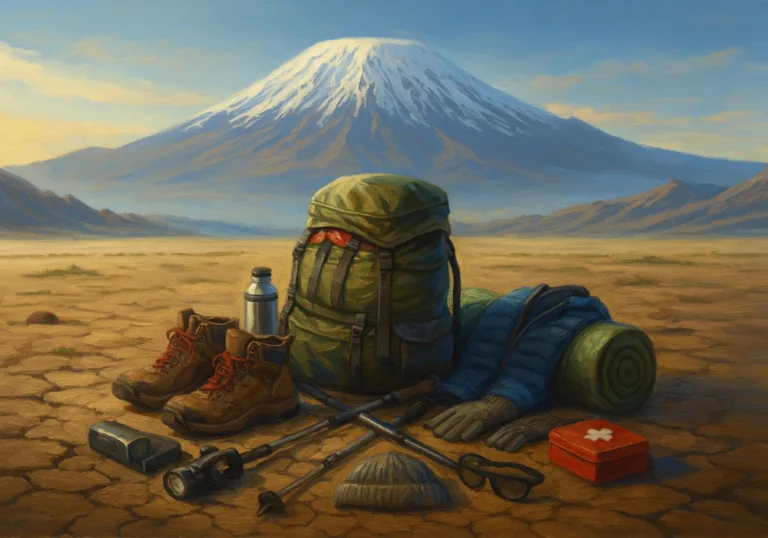
The right equipment is essential for tackling the sometimes extreme conditions of Kilimanjaro. If you already own technical clothing, this will reduce your expenses.
Otherwise, you should expect to pay between $200 and $500 to rent equipment for a week, such as thermal clothing, sturdy hiking boots and a cold-weather sleeping bag.
You can also read our article dedicated to mountaineering equipment if you want to buy your own.
Factors influencing the cost of a Kilimanjaro climb
The budget for climbing Kilimanjaro can vary considerably depending on a number of factors. These elements will directly influence the amount you have to pay for this adventure.
Trek duration
There are several itineraries for your ascent, lasting between 5 and 9 days. The length of the trek will influence its cost. The longer the trek, the higher the costs, as you will have to pay extra for guides, porters, accommodation and meals.
For your general knowledge, the record time for the climb is 6 hours.
However, choosing a longer itinerary can increase your chances of success, by allowing better acclimatization to altitude. For example, a 7-day trek on the Lemosho route can cost 15-20% more than a 5-day trek on the Marangu route.
You should also be aware that the route you choose will directly influence the variety of scenery you see. Going fast is one thing, but seeing unique landscapes is also part of the adventure and experience.
Selected season
The season in which you choose to climb also has a significant impact on the price.
The high season, from June to October, offers the best weather conditions, but agency and flight prices are generally higher.
The low season sees fewer tourists and therefore lower prices, but rain is almost guaranteed and conditions at the summit are changeable, making your chances of reaching the summit less significant.
Agency or local guide?
The choice between an international agency and a local guide also affects costs.
International agencies often offer all-inclusive services, including comfortable accommodation and premium assistance, but their prices can reach $4,000 to $5,000 per person, especially those targeting a US audience.
Local guides, often affiliated with Tanzanian agencies, offer more affordable prices (from $2,000 to $2,500), but sometimes require additional logistics such as flights or equipment.
Number of carriers
The number of porters required for a Kilimanjaro ascent depends mainly on the length of your trek, the chosen itinerary, and the total weight to be carried.
On average, each trekker is accompanied by 3 to 5 porters (including the chef), and sometimes more for longer itineraries or if you choose premium services.
Why so many carriers?
Porters are responsible for carrying tents, food, water, and sometimes even some of your personal luggage. Their role is crucial to your comfort and the success of your climb. And don’t forget that each porter must carry no more than 18kg.
The cost per porter in Tanzania varies, but porter remuneration is increasingly regulated to prevent abuse. You should expect to pay between $8 and $15 per day per porter, plus tips in most cases.
If you’re carrying little equipment, you can reduce the number of porters. Premium services, such as spacious tents or elaborate meals, require more staff. Group treks pool resources, reducing the cost per person.
Tip: Check that your agency respects ethical standards for porters. Some low-cost agencies reduce their salaries or working conditions, which can affect the quality of your trek but above all contribute to the exploitation of people who are sometimes barely of age.
The level of comfort you want
The level of comfort you choose for your ascent plays a major role in the total cost.
Here are the 2 main comfort categories, with their characteristics and impact on the budget:
1. Standard economic price
- Accommodation: Comfortable tents, often with thicker mattresses.
- Meals: Varied menus with hot, balanced dishes.
- Services: Experienced guides and basic medical support.
- Budget: Between $2,000 and $3,500.
2. Premium (luxury)
- Accommodation: Spacious tents with camp beds, sometimes with private portable toilets.
- Meals: Elaborate cuisine, often prepared by a dedicated chef.
- Services: Equipment provided, advanced medical assistance, and a sufficient number of porters to maximize your comfort.
- Budget: Between $4,000 and $5,000 or more.
Tip: If your priority is to reach the summit in the best possible conditions, opt for premium comfort. For experienced hikers who are accustomed to the alpine style, the basic option is the most economical and viable solution.
Tips to reduce the cost of your Kilimanjaro climb
Although a trek up Kilimanjaro remains a substantial investment, there are several ways to reduce costs without compromising the quality of your experience.
Compare agencies
Take the time to compare offers from different agencies, paying attention to the services included.
Make sure that the costs of permits, guides, porters and meals are detailed in the quote. Check online reviews to avoid agencies offering low prices, which are often synonymous with poor conditions for porters.
Book in advance
Early booking often leads to attractive discounts, especially on agency services. Try to plan your trek 3 to 6 months in advance to benefit from the best rates.
Group travel
Joining an organized group or forming your own can considerably reduce costs. Expenses for guides and porters are shared, reducing the budget per person.
What’s more, agencies often offer discounted rates for groups. From 4 people upwards, you can reduce the price you pay for each person by several hundred euros.
Limit the number of carriers
Carrying your own bag and checking the equipment and food you’ve brought with you will limit the number of porters needed.
I like to think that someone who carries their own bag, doesn’t need a portable toilet and doesn’t want 18 sauces for their dishes or a choice between tea, coffee and chocolate can get by with 3 porters. This limits the price you pay, knowing that you won’t need to tip people who aren’t there.
Example budgets for a Kilimanjaro trek
To give you a clearer idea, here are some examples of budgets according to the level of comfort and services required.
Budget for an economic ascent
- Estimated cost: $2,000 – $2,500
- Basic accommodation before and after the trek.
- Local agency with standard services.
- Minimalist equipment rented or brought along (as purchased for other climbs)
- Short itinerary (5-6 days).
This type of budget is suitable for adventurers who are prepared to forego a certain level of comfort in order to save money.
Budget for a premium ascent
- Estimated cost: $4,000 – $5,000
- Comfortable accommodation before and after the climb.
- An international agency offering all-inclusive service, including high-end tents and elaborate meals.
- Medical assistance and specialized equipment included.
- A longer itinerary to maximize your chances of success.
This option is ideal for those who want to enjoy the experience in optimum conditions, with maximum safety and comfort.
Conclusion
Climbing Kilimanjaro is an unforgettable adventure, but it requires rigorous preparation, particularly in terms of finance.
By understanding the different costs and adopting strategies to reduce them, you can plan your trek with peace of mind.
Take the time to compare options, assess your needs and choose the best period to maximize your experience.
Ready to take up the challenge? All you have to do is pack your bags and set off to conquer the roof of Africa!