
How to prepare for a Kilimanjaro climb: the Ultimate Guide ?
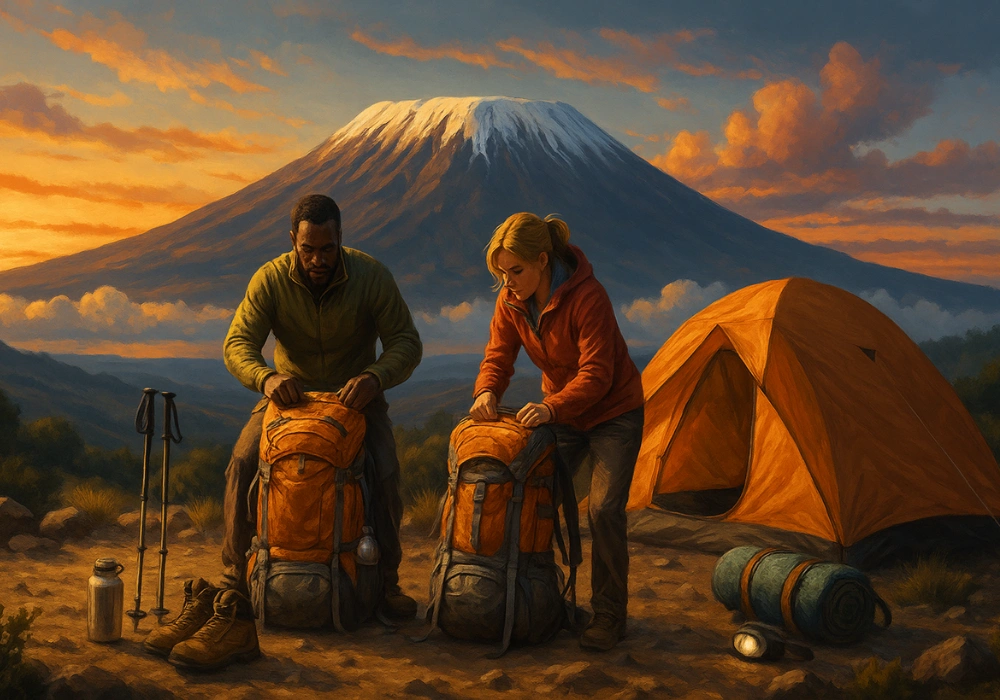
Imagine yourself facing the immensity of Kilimanjaro, a legendary mountain that stands proudly at 5,895 meters, defying the heavens.
Every year, adventurers from all over the world, driven by the desire to surpass themselves, dream of reaching this summit, the roof of Africa. But this dream can’t be achieved by passion or will alone.
Climbing Kilimanjaro is a physical and mental test of your innermost limits.
The key to success lies long before the day of departure: in your preparation. Because up there, every step becomes heavier, every breath rarer, and it’s your endurance and resilience that will carry you to the summit.
In this article, let us guide you through an adapted training program, so that when you set foot on this mythical land, you’ll be ready to face this challenge, body and mind in harmony.
Your free quote for climbing Kilimanjaro
Prepare your adventure with complete peace of mind: receive a personalized estimate within 24 hours, tailored to your dates, your level, and your wishes.
Why is good physical preparation essential for Kilimanjaro?
How fit are you for Kilimanjaro?
Climbing Kilimanjaro is more than just a hike.
At altitudes of over 5,900 metres, the extreme conditions put your body to the test.
Good physical preparation is not only an asset, it’s essential if you’re to make a success of this climb.
This mountain, although technically accessible to numerous people, still requires solid stamina and the ability to manage fatigue and altitude-related respiratory difficulties.
Let’s take a closer look at the specific physical challenges you’ll face.
The importance of endurance
In addition to the altitude, the length of the climb demands intelligent energy management.
Walking between 5 and 8 hours a day at altitudes above 3,000 metres requires a good level of physical fitness to maintain a prolonged effort, without depleting all your physical reserves too quickly.
Endurance is undoubtedly the most crucial physical quality for climbing Kilimanjaro.
It’s not a race against time, but rather a challenge of consistency.
Local guides constantly stress the principle of “Pole Pole” (Swahili for “slowly, slowly”): walk at a slow, steady pace to conserve energy and acclimatize to the altitude.
Effort management is also essential. Inexperienced hikers tend to rush at the start, wasting energy in the first stages of the climb.
Good preparation will help you learn to pace your effort, getting used to walking long distances at a moderate pace with a backpack.
How do you train climbing Kilimanjaro?
Preparing to climb Kilimanjaro requires a comprehensive approach combining endurance, strength and acclimatization.
Your training program must be adapted to the specific conditions of the climb: long days of walking, carrying a rucksack, coping with altitude and climatic variations.
Let’s take a closer look at the different aspects of training.
Cardio exercises
Cardio is essential to improve your endurance and your ability to handle long walks at altitude.
The aim is to increase your lung capacity and resistance to prolonged effort.
Outdoor hiking
Regular hiking is the most suitable exercise, ideally on hilly or mountainous terrain. This simulates the conditions of Kilimanjaro and allows you to get used to prolonged walking with a backpack.
Running
Running several times a week is excellent for building cardiovascular endurance. Vary the terrain, including climbs to mimic climbing conditions.
Endurance sport
These endurance sports are also highly effective in strengthening the heart and lungs, while also working the leg muscles. Cycling, for example, helps build stamina, while swimming improves breathing and provides a full-body workout. Squash is also a great alternative.
Training at altitude (if possible)
Training at altitude is an effective way of preparing your body for the rarer oxygen you’ll encounter on Kilimanjaro. If you have access to high mountains or regions, this is a valuable opportunity to acclimatize.
Hiking at altitude: Climb regularly to over 2,500-3,000 meters to acclimatize your body to the oxygen depletion. This will simulate the effects you’ll feel during a real ascent.
Objective: If possible, hike at altitude 1 or 2 times a month before departure.
Tip: If you live on the plains, you can use attitude chambers or hypoxic tents, which simulate conditions at altitude and improve your ability to adapt.
Muscular strengthening
A strong body will enable you to cope better with long days of walking. You don’t have to be extremely athletic, but you do need to be in good physical and mental condition. The idea is to be a good enough hiker to ensure hours of walking.
Here’s what you need to work on to be ready.
Leg muscles
Your leg muscles will be the most demanding part of your ascent. In fact, you’ll have to assume no less than 4,000 meters of positive ascent (more precisely, 3,795 meters D+ for the more initiated) over a 34 km distance if you take the route Lemosho for your ascent.
For some, it may be one of the biggest efforts of their lives.
To work your leg muscles, focus on strengthening the quadriceps, hamstrings, calves and glutes. Exercises such as squats, lunges and bench presses are excellent for building leg strength.
Core strengthening
Your core (abdominals, obliques, lower back muscles) is essential for stabilizing your body and protecting your spine, especially when carrying a backpack.
Nota bene: In many cases, tourists choose to have their packs carried by porters. However, you’ll still need to carry your own water and snacks for the climb. This represents 3 to 4 kg for 6 to 10 hours.
Exercises such as planks, sheathing and back extensions are essential.
Shoulders and back
Wear a weighted backpack when training to strengthen shoulder and back muscles. This also prepares your joints for prolonged exertion.
Objective: Integrate muscle-strengthening sessions 2 to 3 times a week, with an emphasis on legs and core.
Tip: You won’t necessarily need to carry your entire week’s pack on your back, as a team of porters will be included in the price of your expeditions. You’ll still need to be able to carry your water, a few snacks and jackets (windbreaker and down jacket).
A typical training program for climbing Kilimanjaro
Here’s an example of a 12-week program to prepare for the climb.
Of course, it’s possible to pack lighter, but if you’re reading this, you’re not in the frame of mind to arrive at the next camp every evening after sunset. The idea is for you to be able to hike and enjoy camp life at the end of the day, before the sun goes down.
Weeks 1 to 4: Start of muscular and cardio training
You need to start light, with 2 cardio sessions (hiking, running, cycling, squash) per week, complemented by 2 strengthening sessions (lunges, squats, sheathing). These can be done in the same session.
Add to this a 2-hour walk with a light rucksack (3 to 5 kg) to acclimatize the body.
Weeks 5 to 8: Increase in intensity
It’s time to add one session per week. Move up to 3 cardio sessions per week with increased durations (1 to 2 hours of walking/running with elevation gain (minimum 300m D+)) complemented by 3 strengthening sessions with additional weights. At least one strengthening session should be performed independently.
It’s also time to start hiking with a 5-8 kg backpack. At least 2 hours of hiking per week. If possible, once every 15 days, hikes lasting more than 4 hours.
Weeks 9 to 12: Specific preparation
It’s time to turn up the volume. You should do 4 cardio sessions, including at least 1 long hike per week (4 to 6 hours with an 8 kg bag).
Strengthening sessions (2 to 3 a week) are becoming increasingly important, especially those involving uphill walks. And of course, altitude is best, if possible, combined with walks in difficult conditions, rain or wind.
By following this rigorous program, you’ll be physically ready for the challenges of climbing Kilimanjaro.
Mental preparation
While climbing Kilimanjaro requires rigorous physical preparation, the mental aspect is just as crucial to reaching the summit.
Physical fatigue, extreme conditions and altitude will put your mind to the test. Mental preparation is therefore essential to maximize your chances of success.
Prepare mentally for exercise
Climbing Kilimanjaro is a test of endurance, not only for the body, but also for the mind. So it’s important to prepare your mind to handle the prolonged effort and moments of doubt that may arise.
Positive visualization
It’s a technique used by the greatest champions of our time. A technique used by Michael Jordan, it is said to have helped him visualize the 3 points he needed to score in the championship.
In the same way, imagine yourself already at the summit, feeling the satisfaction of having accomplished this feat. Visualization is a powerful technique for maintaining your motivation throughout the climb.
Practice projecting yourself into difficult moments and visualizing the stages when you overcome obstacles.
Accepting discomfort
It’s essential to be prepared to accept and manage physical and mental discomfort. Muscle pain, lack of oxygen and unpredictable weather conditions are inevitable.
Rather than fight against these sensations, accept them as part of the adventure and prepare to go through them with patience.
Building resilience
During your preparation, include exercises that strengthen your mind, such as outings in difficult conditions (bad weather, uneven terrain).
For example, don’t hesitate to do a session lasting several hours in the rain. It’ll be horrible, you’ll come home soaked. But it will get you used to doing unpleasant sessions.
It gets you used to remaining determined even in uncomfortable situations.
Techniques for staying motivated along the way
Even with excellent preparation, there will be times when motivation wanes. Here are a few techniques to keep your spirits up and your focus on your goal.
Break the goal down into smaller steps
Instead of focusing solely on the summit, set yourself mini-goals along the way. This could be reaching the next camp, completing a day’s hike or overcoming a difficult stage.
Every (small) success will boost your self-confidence and encourage you to keep going.
Rely on group support
Kilimanjaro is often climbed in teams.
Take advantage of this group dynamic to encourage each other. Talk to your hiking companions, share anecdotes or moments of doubt.
Receiving and giving support will also significantly boost your motivation.
Mantras and positive thoughts
Repeat to yourself simple phrases that help you stay focused, such as “one step at a time” or “I can do it”.
Mantras are very effective for maintaining a positive attitude when fatigue and doubt set in.
Take time to enjoy the experience
Kilimanjaro offers breathtaking panoramas at every step.
Take the time to stop, breathe and appreciate the beauty that surrounds you. These moments of wonder can renew your motivation and remind you why you took on this challenge in the first place.
Other crucial aspects of preparation: nutrition and hydration
Suitable nutrition before and during the climb
Your diet must support both : your training and your specific needs during the climb.
Before you set off, a nutrient-rich diet will help you build up solid energy reserves. During the climb, your body will need quality calories to maintain energy levels and aid recovery.
Before the ascent
In the months leading up to your departure, adopt a balanced diet rich in proteins, complex carbohydrates and healthy fats.
Proteins, found in lean meats, legumes and dairy products, help repair muscles, while complex carbohydrates (quinoa, brown rice, sweet potatoes) provide the energy you need for your workouts.
Healthy fats (avocados, nuts, olive oil) are also crucial to support your long-term efforts.
During ascent
Your diet should focus mainly on foods that are easy to digest and high in calories.
Fast carbohydrates, such as energy bars, dried fruit and nuts, are quick sources of energy during breaks. Main meals should include complex carbohydrates to provide energy over time, combined with protein to aid muscle recovery after a day’s walking. Regular snacks are also recommended to keep energy levels constant.
Don’t forget that altitude also affects appetite, so eating foods you enjoy is essential to encourage you to eat enough, even if you lose your appetite.
The importance of hydration to avoid altitude sickness
Hydration is one of the keys to preventing altitude sickness, which can seriously affect your ability to complete the climb.
At high altitude, the body loses more water through breathing and perspiration, and the sensation of thirst is often reduced, which can quickly lead to dehydration.
Why is hydration crucial?
One of the main causes of altitude sickness is dehydration.
At high altitude, the air is drier and water loss through respiration increases. Even mild dehydration can aggravate altitude sickness symptoms such as headaches, nausea and fatigue.
Good hydration maintains blood volume, improves oxygenation and helps acclimatize the body to altitude.
How many liters should I drink during the climb?
It is recommended to drink at least 3 to 4 liters of water a day during the ascent.
Remember to spread hydration throughout the day, drinking small amounts regularly rather than large quantities all at once.
You can also use supplements such as electrolytes or rehydration salts to compensate for mineral loss and avoid muscle cramps.
What are the signs of dehydration?
Stay alert for the first signs of dehydration, such as dry mouth, dark urine or headaches.
In the mountains, these symptoms may indicate that you need to increase your water intake to prevent more serious complications.
Conclusion
Kilimanjaro is a unique experience.
I highly recommend it. Having done Mount Kenya and Kilimanjaro in 15 days, I’ll always do Kilimanjaro again without hesitation. It’s a unique mountain, firstly because, like it or not, it’s still the highest in Africa, and secondly because it’s a whole ecosystem in itself.
Every day, you’ll see a new life being created in every camp you stay in. You’ll see lifelong friendships made in groups of backpackers. Whether you’re the first or the last to arrive, it doesn’t matter as long as you enjoy yourself.
In fact, that would be our last recommendation to you: never forget to enjoy life, it’s short, so you might as well appreciate it. It’s a once-in-a-lifetime thing, in the words of someone who’s lived it.
We hope this guide will help you make that dream come true.