Marangu Route Kilimanjaro: The Coca-Cola Route Guide
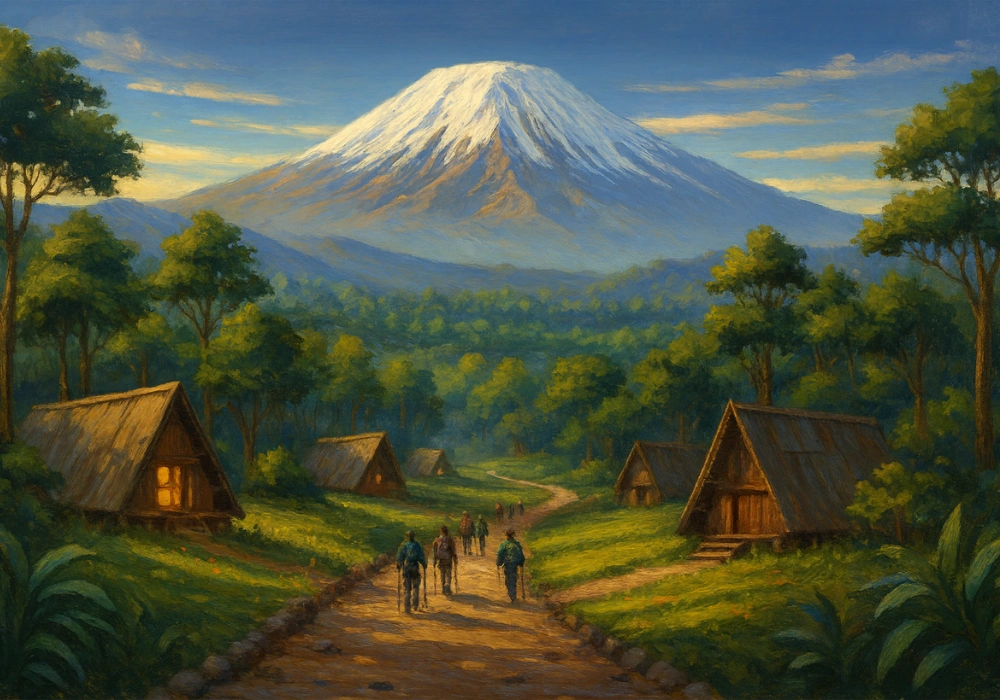
Dreaming of climbing Kilimanjaro, Africa’s iconic summit at 5,895 meters, and looking for the most accessible way to take on the challenge?
The Marangu Route, nicknamed the “Coca-Cola Route”, is the oldest and most comfortable itinerary to attempt the roof of Africa. It is the only route offering permanent huts instead of tents, which makes it a favorite among trekkers looking for some comfort without sacrificing the adventure.
In this article, we cover everything you need to know about climbing Kilimanjaro via the Marangu Route: day-by-day itinerary, difficulty level, essential gear, the best time to go, and physical preparation. Whether you’re new to high-altitude trekking or simply looking for a first experience above the clouds, this route is an excellent starting point.
And to live this adventure in the best conditions, trust our partner agency Jambo Kilimanjaro, specialists in tailor-made treks with certified guides. Book your Marangu Route climb today and turn your African dream into reality.
Your free quote for climbing Kilimanjaro
Prepare your adventure with complete peace of mind: receive a personalized estimate within 24 hours, tailored to your dates, your level, and your wishes.
Why choose the Marangu Route to climb Kilimanjaro?
An overview of the Marangu Route: what to expect
General overview
The Marangu Route, often called the “Coca-Cola Route”, is one of the most accessible itineraries for climbing Kilimanjaro. This 5 to 6-day trek is the only route offering permanent huts instead of tents, providing real comfort to trekkers.
The itinerary follows the southeastern slope of the mountain, with a gradual ascent through rainforest, alpine moorland, and then alpine desert. Less technical than other routes, the Marangu remains a real challenge due to its rapid ascent profile, which can limit acclimatization.
Why is it called the Coca-Cola Route?
The Marangu Route is nicknamed the Coca-Cola Route in contrast to the Machame, known as the “Whiskey Route”. The name comes from the fact that you can buy soft drinks in the huts, making it a more comfortable and touristy option. It’s the only route with permanent huts offering a roof, a mattress, and sometimes even drinking water, which makes it more accessible and popular.
Why it’s legendary
The Marangu is the oldest climbing route on Kilimanjaro and the path by which thousands of trekkers have tried their luck for decades. Despite its reputation as an “easy” route, it remains a physical and mental challenge, especially due to its faster acclimatization profile. Its legendary status also comes from its history, its retro atmosphere, and the fact that it leads, like all the others, to the roof of Africa.
When is the best time to climb Kilimanjaro via the Marangu Route?
The best time to tackle the Marangu Route corresponds to the dry seasons: from January to early March, and from June to October. These periods offer stable weather conditions, ideal for trekking and maximizing your chances of success.
On the other hand, April, May, and November are marked by heavy rainfall that makes the experience more difficult. For optimal comfort and support, go with a specialized agency like Jambo Kilimanjaro, our trusted local partner.
Pros and cons of the Marangu Route
Advantages of the Marangu Route
- One of the most comfortable itineraries, thanks to nights in equipped huts (no tent camping)
- Ascent and descent along the same trail, which simplifies logistics
- Well-maintained trail, with no technical sections or steep passages
- Ideal for trekkers looking for a more accessible and structured experience
Disadvantages of the Marangu Route
- More challenging acclimatization: the ascent profile is fast, which increases the risk of altitude sickness
- Less landscape variety, especially on the descent, since the itinerary is identical both ways
- Summit success rate slightly lower than the Machame, often linked to insufficient acclimatization
- A more “highway” than wilderness atmosphere, with less of an expedition feel
Day-by-day itinerary of the Marangu Route
Day 1: Marangu Gate (1,870 m) – Mandara Hut (2,700 m)
Distance: ~8 km · Duration: 4 to 5 hours · Elevation gain: +830 m Environment: Dense tropical rainforest
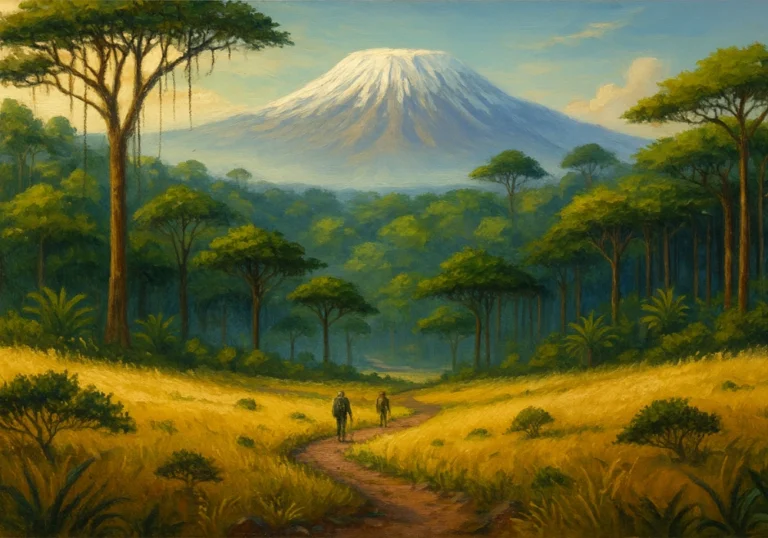
The hike begins in the rainforest, on a damp and shaded trail where you may spot colobus monkeys or colorful birds. The ascent is gentle but steady, surrounded by lush vegetation. After 4 to 5 hours of walking, you reach Mandara Huts for your first night under a roof.
Atmosphere
- Shaded and humid trail
- Possible sightings of colobus monkeys
- First night under a roof at Mandara Hut
💡 Our tips: Wear waterproof boots and walk slowly from the start.
Day 2: Mandara Hut – Horombo Hut (3,720 m)
Distance: ~12 km · Duration: 6 hours · Elevation gain: +1,020 m Environment: High-altitude moorland
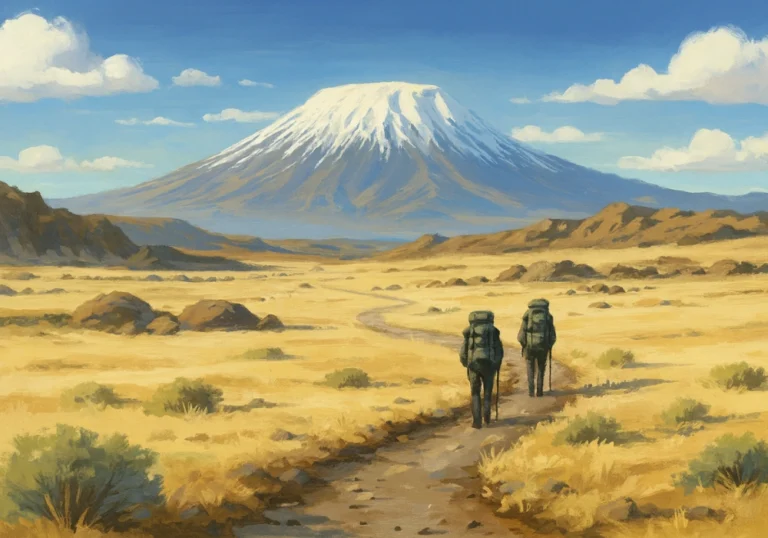
You gradually leave the forest behind and enter a zone of alpine moorland, with clear views of the ridges and the Mawenzi summit. The landscape becomes drier and more expansive, and the horizon opens up. After about 6 hours of walking, you reach Horombo Hut, a rest spot with a spectacular panorama.
Atmosphere
- Open landscapes with views of Mawenzi
- Gradual ascent
- Night at Horombo with summit panorama
💡 Our tips: Stay regularly hydrated and apply sunscreen — sun exposure is stronger up here.
Day 3: Horombo Hut – Kibo Hut (4,700 m)
Distance: ~10 km · Duration: 6 hours · Elevation gain: +980 m Environment: Alpine desert, arid and rocky
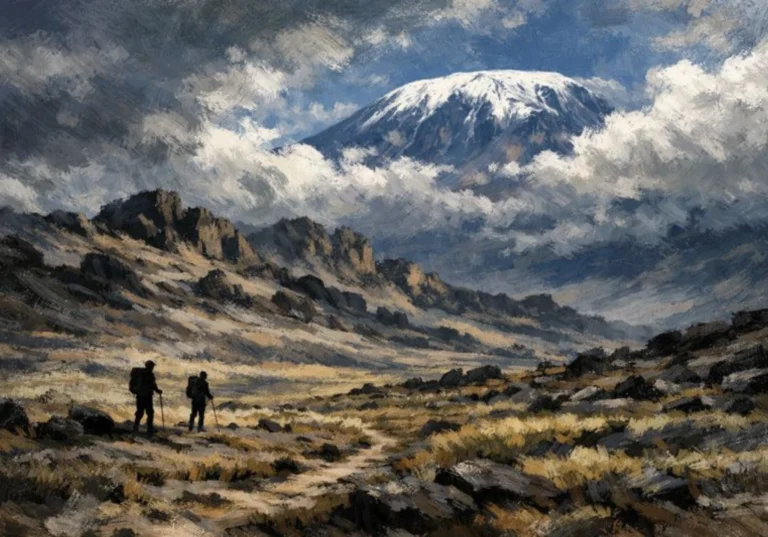
This day takes you into the heart of the alpine desert, across an arid, lunar plateau. The air is dry, and the effort grows as the altitude climbs. An essential stage to prepare for the summit push, Kibo Hut is the base camp for the final ascent. About 6 hours of walking.
Atmosphere
- Long crossing of a lunar plateau
- The air becomes dry, effort increases
- Last water point at Horombo
💡 Our tips: Walk slowly, eat well, and rest as soon as you arrive.
Day 4: Kibo Hut – Uhuru Peak (5,895 m) – Horombo Hut
Distance: ~21 km · Duration: 12 to 14 hours · Elevation: +1,195 m / -2,175 m Environment: Volcanic slope, summit ridge, then moorland
Departure around midnight for a steep and demanding climb up to Gilman’s Point (5,681 m), then across the ridge to Uhuru Peak, the summit of Africa. Arriving at sunrise is unforgettable. The descent is long and grueling, all the way back to Horombo Hut. In total, expect 12 to 14 hours of walking.
Atmosphere
- Bitterly cold nighttime departure
- Arrival at Gilman’s Point, then Uhuru at sunrise
- Long, tiring descent to Horombo
💡 Our tips: Prepare your pack the night before with very warm clothing, a headlamp, and energy snacks.
Day 5: Horombo Hut – Marangu Gate
Distance: ~20 km · Duration: 5 to 6 hours · Elevation loss: -1,850 m Environment: Moorland, then tropical rainforest
The final day of walking takes you through several vegetation zones, from moorland to rainforest. The trail is pleasant and the descent gradual, marking the end of an intense adventure. About 5 to 6 hours before reaching Marangu Gate and exiting the park.
Atmosphere
- Gradual descent through different climates
- Final moments walking through lush vegetation
- Return to civilization
💡 Our tips: Use trekking poles to ease the strain on your knees during the descent.
Optional Day 6: Acclimatization day at Horombo Hut (recommended for beginners)
Distance: ~3-4 km (acclimatization hike toward Mawenzi Ridge) · Duration: 2 to 3 hours · Elevation gain: ~+300 m Environment: Alpine desert, arid and rocky
For those who want to give themselves every chance of success, an extra day at Horombo Hut after Day 2 allows for better acclimatization. This pause significantly reduces the risk of acute mountain sickness and increases the odds of reaching the summit.
Atmosphere
- Easy acclimatization hike at altitude
- Spectacular views of Mawenzi
- Active rest day
💡 Our tips: Use this day to eat well, sleep well, and listen to your body.
How to prepare for your Marangu Route climb
What physical condition is needed to succeed on the Marangu Route?
The Marangu Route is considered one of the most accessible itineraries on Kilimanjaro, but that doesn’t mean it’s easy.
You need to be in good physical condition, able to walk 5 to 7 hours a day for several consecutive days, with an even greater effort on summit day (up to 14 hours of walking).
Altitude, however, spares no one. Strong endurance, a habit of walking, and solid mental preparation are essential to maximize your chances of success.
To discover a complete training plan, along with mental preparation advice, check out our full guide:
How to prepare physically and mentally to climb Kilimanjaro
What gear is essential for the Marangu Route climb?
To face Kilimanjaro’s changing conditions, quality gear is essential. Even on a route with huts, you’ll be exposed to cold, wind, altitude, and sudden temperature swings.
For the complete list, check out our dedicated guide:
Kilimanjaro packing list: everything you need to climb
Marangu Route tip: Although you sleep in huts, bring a cold-weather sleeping bag rated for –10 to –15 °C (14 to 5 °F), because nights at altitude can be freezing even indoors.
How to choose a reliable agency and porter team?
If you want to succeed on the Marangu Route and head toward Africa’s summit with peace of mind, trust your adventure to Jambo Kilimanjaro, an experienced local agency.
You’ll benefit from professional support with certified English-speaking guides, well-treated porters, and complete logistics including transfers, accommodation, balanced meals, and suitable equipment.
With Jambo Kilimanjaro, you walk toward the summit with confidence.
Conclusion: the Marangu Route, the comfortable way to climb Kilimanjaro
The Marangu Route is an excellent compromise for trekkers looking for a more direct itinerary, with a moderate technical level and more comfortable infrastructure.
With the right support, this route offers a memorable adventure toward the roof of Africa, accessible to everyone ready to take on the challenge.
For a well-supported climb, consider booking with our partner Jambo Kilimanjaro, specialists in tailor-made treks on this historic route.